Avian Cognition: Carrion Crows Match Primate Speed
New data shows birds use the same decision logic as primates but process visual evidence in half the time.
By Thomas Rogers ·
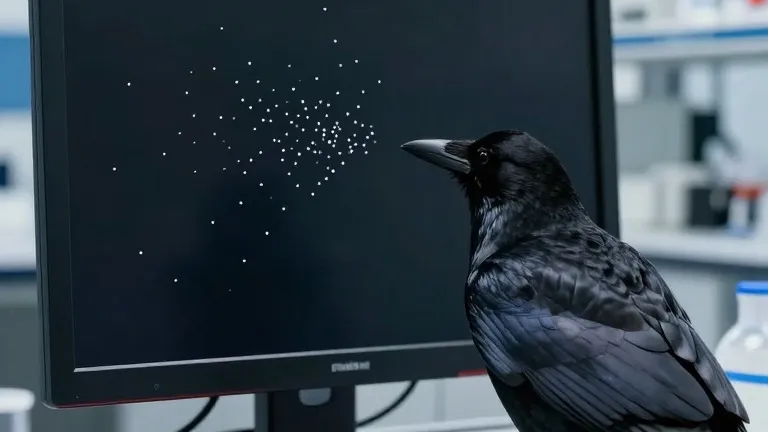
Carrion crows now demonstrate the same visual decision-making logic as primates, but they complete the process twice as quickly. This finding challenges the long-held assumption that complex decision-making requires a neocortex, a brain structure birds lack.
Researchers at the University of Tübingen designed the study to address this gap in understanding. Andreas Nieder, a neurobiologist on the team, noted that the organization of the avian brain remained a mystery in this context. "This was the big question," Nieder said. "How [would] a differently organized avian brain encode decisions?"
The scientific community has relied on the random-dot-motion task for decades to understand how brains process ambiguous visual information. In previous experiments, monkeys observed clouds of flickering specks drifting weakly in one direction. Neurons in their neocortices collected this visual evidence over time. Firing rates climbed until they crossed a threshold, triggering a committed choice. Because birds do not possess a neocortex, it was unclear how they handled similar cognitive loads.
To test this, Nieder and colleague Philipp Schmidbauer subjected two hand-raised carrion crows to the identical task. The birds sat before a touch-sensitive monitor displaying white dots on a black background. A fraction of the dots drifted together in one of four directions. The crows indicated their perception by pecking one of the targets flanking the display. Correct answers were rewarded with a mealworm.
The team varied the difficulty of the task by adjusting the percentage of dots moving coherently. The easiest condition involved 81 percent of dots moving together, a trivially easy signal. The hardest condition involved only 3 percent, barely distinguishable from noise. A zero percent condition was also included to test for false positives.
Nieder emphasized that the experimental setup mirrored the monkey version exactly. "We intentionally wanted to have exactly the same random-dot motion task," he said. "The only difference was that the crows had to peck to indicate their decision, whereas monkeys were indicating by making an eye movement."
The results show that the crows used the same mathematical logic as primates to resolve the visual ambiguity. They accumulated evidence until reaching a threshold, just as the monkeys did. However, the crows reached that decision point in half the time. The data confirms that a brain without a neocortex can execute comparable decision-making processes with greater speed.
Source: Ars Technica