Mars Cloud Formed Without Dust or Salt, Model Shows
Simulations of the Arsia Mons Elongated Cloud reproduce its growth only when vapor freezes directly into ice crystals without particles to seed it.
By Kevin Sanders ·
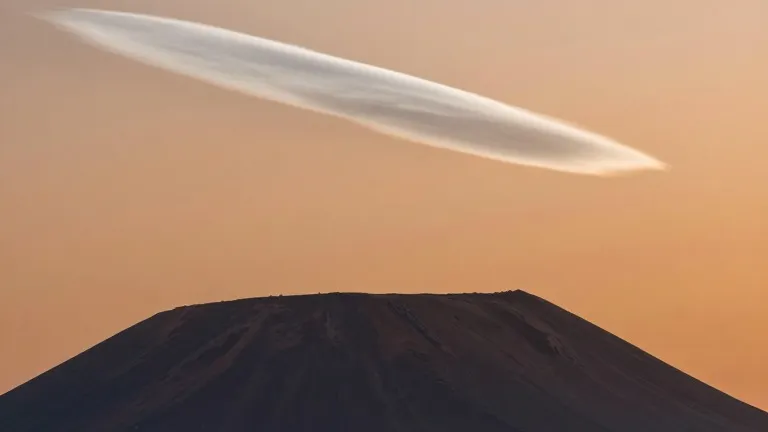
A cloud that stretches more than 1,000 miles across the Martian sky each morning may form through a process that has never been observed in any planet's atmosphere, according to a study published in Nature Geoscience. The Arsia Mons Elongated Cloud, first recorded by a probe in 2018, grows through the morning until it spans a distance comparable to the straight-line run from New York to Kansas City, then dissipates. The cycle repeats over several months during Martian spring and summer.
The new model is the first to reproduce the cloud's growth. Lead author Jorge Hernández-Bernal, a planetary scientist at Sorbonne Université in Paris, said the simulations ran only after his team added what he called "exotic physics." The process, homogeneous nucleation, turns vapor directly into ice crystals without dust or salt particles to seed them. On Earth, clouds typically condense around such particles. "Once we included this physics in our simulations, the AMEC emerged just as we hoped," Hernández-Bernal said in a press release.
The mechanism requires a temperature drop of 30 degrees Celsius within 10 minutes alongside high relative humidity. Arsia Mons, a volcano standing 65,000 feet tall, supplies those conditions: wind striking the mountain generates a wave that lifts moist air high into the atmosphere within minutes. The humidity involved exceeds 100,000 times any value measured on Earth.
Scientists have long assumed homogeneous nucleation could occur in the upper atmospheres of Venus and Earth, but no one has observed it. Researchers also did not previously know that such humidity existed on Mars. The humidity requirement may explain why the process has gone unobserved elsewhere.
Hernández-Bernal said reproducing the cloud to this degree is a notable result given how much less is known about the Martian atmosphere compared with Earth's. "The result is remarkable," he said.
Source: Wired