Palestinian voters in Israel face record stakes in Tuesday's election
Turnout is expected to jump sharply as citizens seek protection from a government that has promised displacement and increased violence.
By Kenji Yamamoto ·
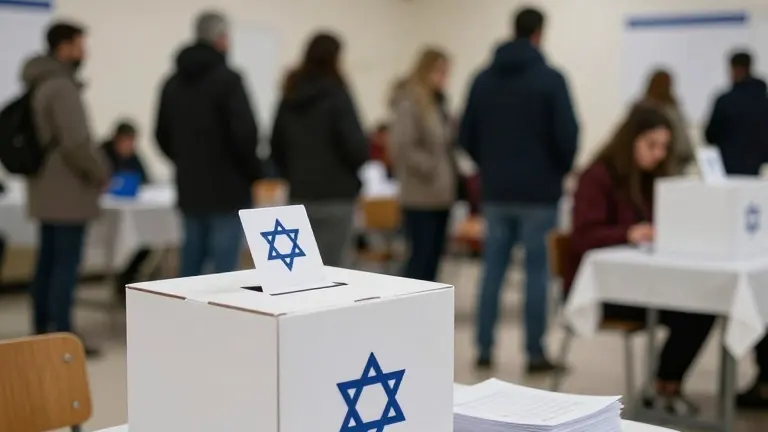
Ibrahim Said, a 70-year-old resident of the Galilee, has not voted in an Israeli election since 1980. For decades, he ignored campaign promises from parties that pledged to defend the interests of Palestinian citizens and return the lands his family lost during the 1948 Nakba. On Tuesday, however, Said plans to cast a ballot for the first time in 46 years. He cites a new climate of fear as the driving force behind his decision. "Without a doubt, we must vote this time. We are living in fear," he said.
The election occurs four years after Benjamin Netanyahu returned to power with a coalition that includes Jewish supremacist allies Bezalel Smotrich and Itamar Ben Gvir. During this period, the source notes that life in the occupied West Bank has faced economic strangulation and settler attacks, while Israel waged a war in Gaza. For Palestinian citizens inside Israel, the shift has brought organized crime and violent discrimination. Three political parties have made the deportation and displacement of Palestinians a central part of their campaigns. Smotrich’s Religious Zionism party specifically promises to "Judaise" the Galilee and Negev, regions where hundreds of thousands of Palestinians live.
Ameer Fakhoury, an analyst at the Vanleer Institute, predicts voter turnout could reach between 68 and 73 percent. This would be a major increase from the 54 percent turnout recorded in the 2022 election. Such a surge could allow the Joint List and Raam parties to secure approximately 15 of the 120 seats in the Knesset, matching the high recorded in 2020. Fakhoury argues that this participation reflects a lack of confidence in state institutions rather than trust in the democratic system. "We are voting to prevent displacement and protect the most basic conditions of our existence," he said.
Jowan Safadi, a musician who has traditionally boycotted Israeli elections, is reconsidering his stance. He has long viewed the electoral process as a "democratic facade" because only the 2.1 million Palestinian citizens of Israel can vote, a group that makes up 20 percent of the country’s population. Safadi notes that the current government’s extremism demands action. "My only hope is that changing the people in power might bring someone who is slightly less barbaric and sadistic," he said. He credits the hardline rhetoric of Smotrich and Ben Gvir with compelling voters to act, stating that these leaders have effectively campaigned for the Arab electoral lists.
The sense of urgency is also driven by rising violent crime in Palestinian communities. Last year, there were 252 homicides in these areas. In the first half of 2026, police recorded 147 more killings. Authorities solved only 12 percent of those cases this year. Adham, a mechanic in northern Israel, stays up until his two adult sons are home, refusing to let them stay out past 10 p.m. He plans to vote for Mansour Abbas’ Raam party, which includes Yoav Segalovich, a former police major-general, on its list to address crime.
Maha Mohammed, a teacher in the northern town of Umm al-Fahm, describes a pervasive anxiety that extends beyond her neighborhood. She feels afraid when visiting mixed Arab-Jewish cities, including her hometown of Jaffa. As a woman who wears the hijab, she reports feeling anxious about how her religious identity is perceived by those around her. The women of Umm al-Fahm identify safety for their families and neighbors as their primary concern. "It is the most basic thing they are asking for," Mohammed said.
The election takes place against a backdrop of internal debate among Palestinians. Some community members remain divided over whether participation or boycott is the more effective strategy. Safadi admitted he could not sleep after posting on social media that he might vote this year. He questioned how he could choose among the available candidates. Despite his apprehension, he believes the alternatives to voting could be worse under the current political arrangement.
Source: Middle East Eye