
Sanctioned Tankers Stall in Vilkitsky Strait as Arctic Trade Faces Ice Limits
Russia's Northern Sea Route handled a record 20 million barrels of oil by mid-October, but ice jams and sanctions continue to constrain capacity and costs.
By Kevin Sanders ·
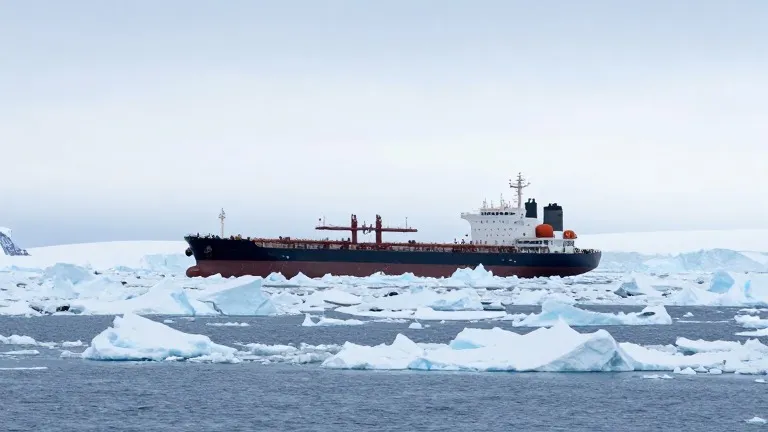
In July, a fleet of sanctioned Russian tankers became trapped in ice within the Vilkitsky Strait. Located above the Arctic Circle, the 55-kilometer-wide channel serves as a critical choke point on the Northern Sea Route, connecting the northern Siberian coast to Bolshevik Island. The vessels had to anchor in place while waiting for assistance. Two nuclear-powered icebreakers were days away from the site.
Only one tanker successfully navigated the strait during the incident. The remaining vessels waited for up to two weeks for the icebreakers to arrive. Even with the aid of these heavy ships, the tankers could not clear the packed ice. The group eventually abandoned the direct path and took a different route to complete their voyages.
This operational hurdle contrasts with the Kremlin's narrative of a newly opened and safe Arctic passage. Russian officials promote the route as a way to move crude oil and liquefied natural gas away from Ukrainian drone strikes and potential European naval interference. While cargo volumes have hit record highs this year, physical conditions remain volatile. Ksenia Vakhrusheva, head of the Arctic project at the environmental group Bellona, stated that less ice does not equate to easier navigation. She noted that melting ice can break up and pack tightly in narrow straits, blocking ships that lack specific ice-class ratings.
President Vladimir Putin has labeled the Northern Sea Route a reliable path to global markets. Speaking at the launch of the Vostok Oil project on the Taimyr Peninsula last month, he cited 37 million tons of cargo moved along the route in 2025. He predicted that this volume would almost double by 2030. These targets follow earlier Kremlin goals from 2019, which aimed for 80 million tons by 2024.
Market data suggests a more modest reality for current trade flows. The Center for High North Logistics reported that Russia shipped approximately 2 million tons of crude oil, or 15 million barrels, along the full route to Asian destinations by the end of September. Reuters data, citing traders and shipping records, indicated the total reached about 20 million barrels by mid-October. This represents a 50 percent increase over 2025 volumes but accounts for only 1 percent of Russia's total seaborne oil exports. Tomas Alexa, a senior analyst at Ambrey, described the growth as a surge from a relatively low base.
Western sanctions add another layer of complexity to the logistics. Alexa explained that sanctions hamper Russia's ability to build and maintain Arctic-capable vessels. Spare parts and construction materials often require routing through third parties. Additionally, repair services previously provided by Norwegian, Danish, and Dutch firms are no longer readily available to Russian operators.
International shipping activity on the route is expanding beyond Russia. South Korea reported on October 22 that its first container ship had used the Northern Sea Route. Officials described the journey as a shortcut to Europe but noted difficult conditions, including large ice floes in the Bering and Vilkitsky straits. China also launched its first scheduled container service to Europe along the route this year, completing several voyages.
Strategic questions remain regarding how Moscow will manage the corridor. Catherine Sendak of the Center for European Policy Analysis noted that Russia views much of the Arctic as an inner waterway. Uncertainties persist over potential tolls and the specific services Moscow will offer to commercial vessels. Sendak suggested that Russia might choose to limit access for other actors in the future.
Security considerations are driving policy changes in the region. EU foreign affairs chief Kaja Kallas stated on October 21 that the Arctic has become a front line of global power competition. NATO launched its Arctic Sentry mission in February, and the United States announced plans last month to expand its military presence in Greenland.
Environmental risks accompany the increased traffic. Vakhrusheva warned that oil degrades more slowly in cold conditions and can spread over ice. She highlighted that Russia publishes no official information on incidents along the route. The remote nature of the area means that no independent group can easily report on these events.
Source: RFE/RL
More Business · World news · Business Complaints · Report a business · Got a Story?