Serbia heads to election as student bloc threatens Vučić
A candidate list born from anti-corruption protests enters the ballot, forcing the country's long-time leader into his closest parliamentary contest.
By Kenji Yamamoto ·
Serbia holds parliamentary elections on Sunday, with analysts predicting a tight outcome that could end the dominance of Prime Minister Aleksandar Vučić. The contest pits the long-serving leader against a student-driven movement that has challenged his authority for nearly two years.
The Student List emerged from protests following a structural failure in Novi Sad, the country's second-largest city, where a collapsing canopy killed 16 people. University assemblies selected 250 candidates for the ballot, including academics, athletes, and engineers who lack prior political experience. Ilija Srdanović, a cardiologist and professor at Novi Sad University, heads the list but does not hold formal leadership authority within the group.
Srdanović described his role as supporting the students in their political campaign. He told the BBC that standing alongside his students was a normal part of helping them in a fair struggle. A student at Novi Sad University, identified only as Aleksandra, noted that the list includes top professionals from various fields, a feature she views as a strength of the collective.
Vučić has held various executive roles in Serbia since 2012, serving as deputy prime minister, prime minister, and president. He stepped down as president last month to run for the premiership in this snap election. His supporters point to economic growth and infrastructure projects completed over the past decade. Vučić has characterized the student movement as foreign-backed and intent on dismantling the state.
Critics argue that the ruling Serbian Progressive Party controls state institutions and media coverage. An International Election Observation Mission reported in 2023 that media bias and the misuse of public resources gave the ruling party an overwhelming advantage. A pro-government camp has occupied a park in central Belgrade for 18 months, with residents frequently confronting journalists. Vučić labeled the encampment a symbol of resistance.
The Novi Sad disaster complicates Vučić's position because the station renovation was part of his high-speed rail project connecting Belgrade and Budapest. Magda Anastasijevic, an Eastern Europe analyst at ACLED, stated that Vučić usually survives crises by identifying a scapegoat, but that option was unavailable in this specific incident. Foreign policy issues, including Serbia's balanced relations with the EU, Russia, and China, have also become central to the campaign.
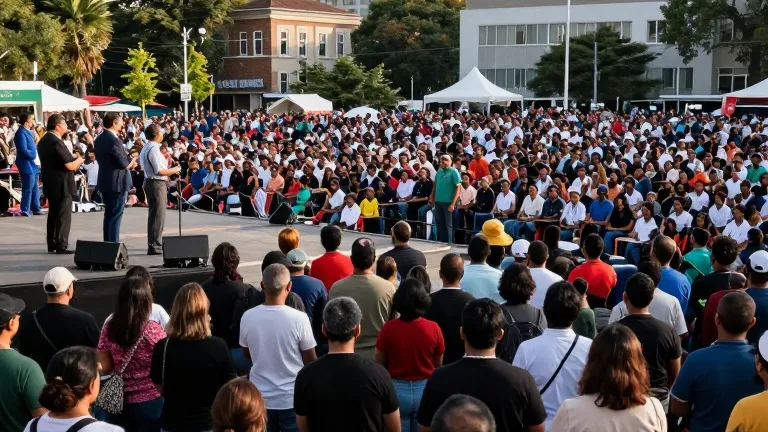
Campaign events in the final days showed distinct differences in style. The ruling party hosted Vučić as the sole speaker at Belgrade Arena, while approximately 150,000 people gathered in Slavija Square to hear from student candidates. Voters face a choice between a centralized leadership model and a collective approach to governance.
Source: BBC News
More Politics · World news · Report a business · Got a Story?