AI Blast Image and Military Dispute Frame Final Push for Netanyahu Before Tuesday Vote
Prime Minister Benjamin Netanyahu links his survival to the Iran threat, while rivals point to reported friction with the army chief of staff as proof of his unreliability.
By Kevin Sanders ·
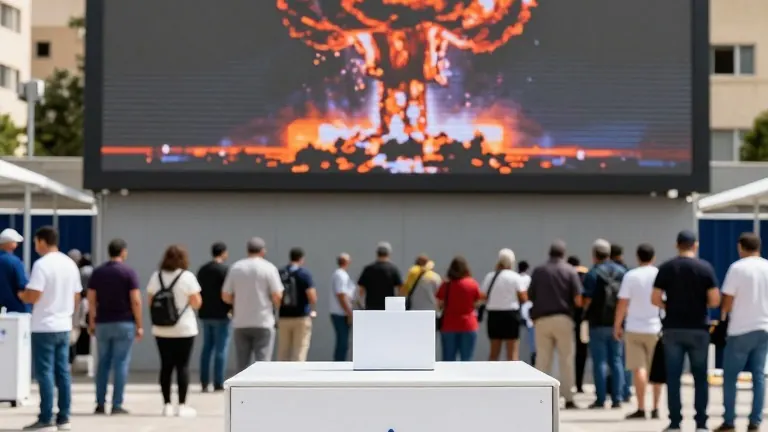
The Israeli election campaign concluded Sunday with a confrontation over the nation's most pressing external threat. Prime Minister Benjamin Netanyahu shared an artificial intelligence generated image of a nuclear explosion over Tel Aviv. He paired the graphic with a warning that his defeat could expose Israel to a second Holocaust. The visual argument moved beyond standard policy debates by tying the state's physical survival directly to his continued tenure.
This tactic sharpens the central conflict facing voters on Tuesday. The race has reduced to a test of trust in the leadership versus the military establishment. Netanyahu argues that his experience and international standing are the only guarantees against an Iranian attack. The change bloc contends that the prime minister can no longer be trusted to separate national security needs from his own political survival instincts.
A report published Sunday night by N12 News intensified the debate. The outlet claimed that IDF Chief of Staff Lt.-Gen. Eyal Zamir resisted an instruction from Netanyahu for an undisclosed military operation. According to the report, defense officials feared the move could trigger a confrontation with Iran. Zamir reportedly sought further deliberations and signed documentation regarding the operation's legal authorization before proceeding.
Netanyahu denied any tension with the military's top brass over Iran. He stated there was no confrontation regarding the specific incident. However, the political weight of the report remains heavy for his opponents. The story suggests that the professional military leadership is actively checking the prime minister's judgment. This allows rivals to argue that Netanyahu is making security decisions for electoral gain rather than strategic necessity.
The timing of the N12 report has fueled skepticism among some voters. Critics note it resembles previously disputed stories, such as the claim that Egyptian intelligence chief Abbas Kamel visited Israel to warn of an attack just before October 7. That earlier report was contradicted after the fact. For some, the new account looks like another anonymously sourced story appearing at a moment of maximum electoral damage. Others view it as essential transparency into internal security disagreements.
The shadow of October 7 complicates these judgments. The date serves as a benchmark for evaluating institutional credibility. The military and intelligence services failed dramatically in their assessments and preparations on that day. This history makes the automatic deference to military judgment more difficult to sustain for some voters. If the security establishment's failure undermines its claim to unquestioned trust, the question remains why the political leadership should emerge from the same disaster with its own claim intact.
Netanyahu bore ultimate political responsibility for security on October 7. His opponents argue that this shared history means neither side holds a monopoly on truth. The change bloc is asking voters to trust that different leaders will manage the same threats more responsibly. Netanyahu is asking voters to trust that his specific experience is the only shield against the Iranian danger. Both arguments rest on the backdrop of a day that exposed the limits of expertise.
The election determines which party will lead the coalition that addresses issues beyond Iran. However, the closing arguments have sharpened the choice into a binary decision about credibility. Voters must decide whose warnings to credit and whose motives to trust. Netanyahu maintains the danger is too great to replace him. His rivals assert it is too great to leave him in place.
Polls open on Tuesday for this decisive vote. The outcome will dictate the direction of Israeli security policy and the balance of power between the prime minister's office and the military command. The AI image of the Tel Aviv blast and the reported friction with Lt.-Gen. Zamir remain the defining images of the final campaign day.
Source: The Jerusalem Post